 |
| Henge, oil on canvas, 50 x 50 cm |

Showing posts with label Prehistoric. Show all posts
Showing posts with label Prehistoric. Show all posts
Saturday, 14 July 2018
Henge


Monday, 21 May 2018
Sentinel: Danebury Hillfort
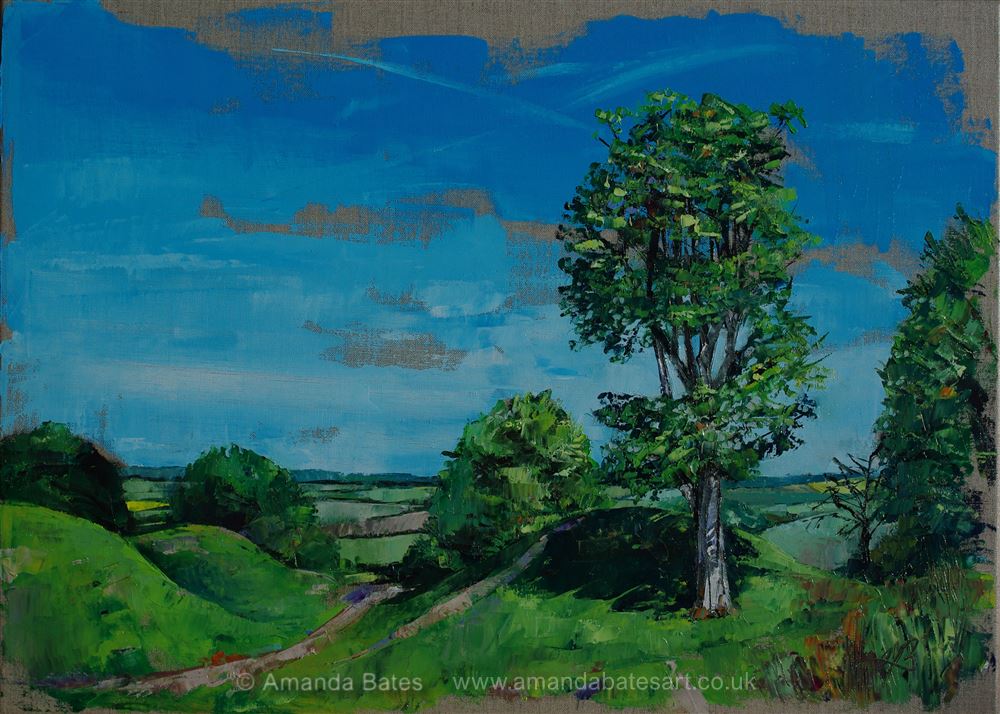 |
| Sentinel, oil on linen, 70 x 50 cm |
The tree stands, tall, proud and solitary, by the entrance to the fort (here, we are looking out of the fort). It made me think of a guardian or sentinel.
Sentinel
oil on linen, 70 x 50 cm
£260
Painted 19 May 2018 in Open Studio
Friday, 20 April 2018
Devil's Den, or, The Resting Place - SOLD
 |
| Devil's Den, oil on linen canvas, 46 x 38 cm |
I have visited the Devil's Den before, with sketching equipment, but this time I took my painting gear. It was a gloriously, unseasonably, hot and sunny day. I spent maybe two and a half hours on site and completed the picture in the studio, where I empasised the darks (which have a tendency to get lost on site) and the reflected colour on the stones.
Included in the group exhibition, Traces of Prehistory (Artikinesis).
Devil's Den
oil on linen canvas, 46 x 38 cm
£160 - SOLD
Friday, 12 May 2017
Entrance (Chysauster)

This is the entranceway to one of Chysauster's "courtyard" huts. Chysauster, in west Cornwall, is a remarkably well preserved iron age village managed by English Heritage.
My painting was made last week while my studio was open as part of Open Studios West Berkshire and North Hampshire. There's still just over a week of Open Studios left; you'll find my dates and details here.
Entrance (Chysauster)
Oil on canvas, 55 x 46 cm
£190
Sunday, 7 May 2017
Step Over (Chysauster)
 |
| Oil on canvas, 40 x 40 cm (03/05/17) |
It's painted from my photograph of the steps over a Cornish Hedge on the approach to Chysauster, an iron age village in Cornwall.
Sunday, 15 May 2016
Danebury - SOLD

Here s one of the latter upon one of the former.
From a photograph, painted in the Open Studio last week.
Oil on linen canvas, 50 x 70 cm
SOLD
Friday, 11 October 2013

Wednesday, 25 September 2013
More Hurlers
At Easter, we visited Bodmin Moor's Hurlers; in July I painted some of them. The painting seemed lonely, and seemed to need a companion piece It's taken me a while to get around to doing it, but I've finally painted a second Hurlers piece.


Monday, 22 July 2013
The Hurlers
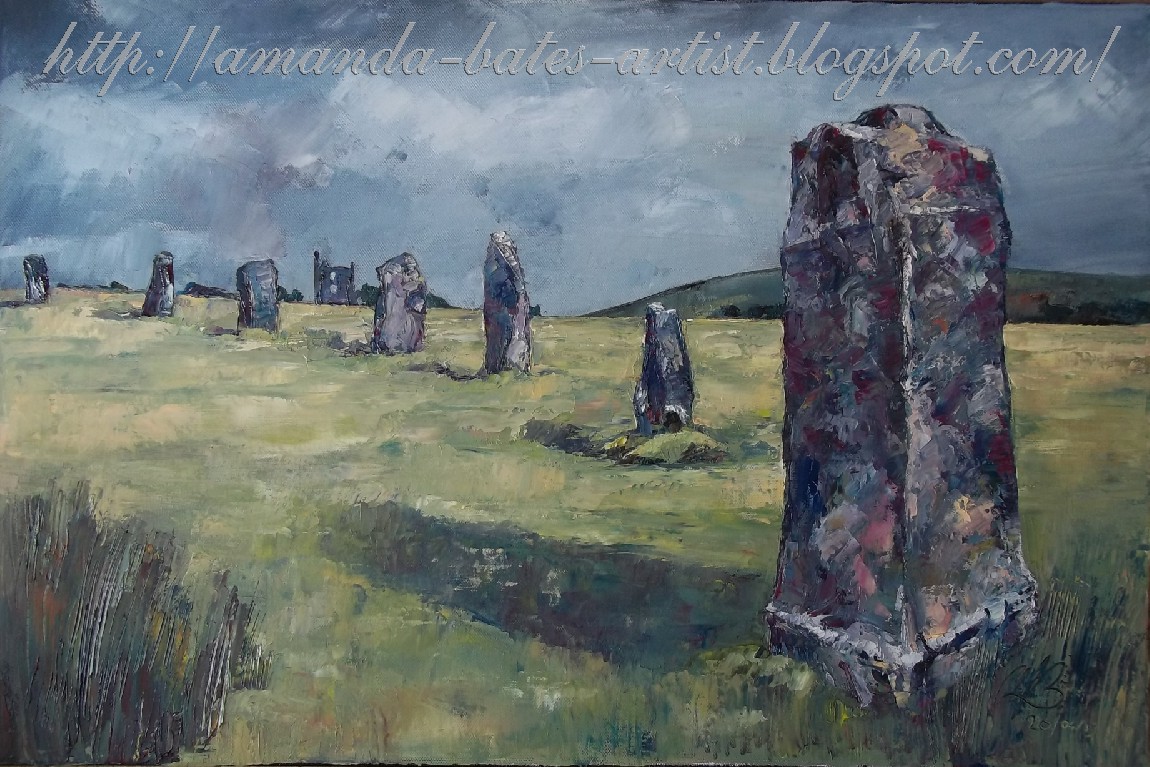
With some justice.
Saturday, 5 January 2013
Barrow Hill, New Year's Day 2013

This is based on a chance-taken photograph from the A303.
We were in a car. It was moving. I was not driving. I caught sight of this striking hill and - because my camera just happened to be in my hand - snapped a shot through the car window. Amazingly, it was in focus. Even more amazingly, the picture included the intended subject.
This procedure very rarely works.
I'm glad it did this time, because the scene has lots of things I like in it. A hill. Trees on the skyline. An interesting sky. And, from the name, which I didn't know at the time, the hint of prehistoric activity.
Palette: Phthalo Blue, Rose Madder, Lemon Yellow, Titanium White.
Oil on canvas, 50 x 40 cm
For sale
Friday, 28 December 2012
Avebury Sheep

Way back in 2007, when my daughter was still learning to walk (it must have been spring), I took her to Avebury, with her pushchair. I also took an old-school 35mm SLR loaded with monochrome film.
My photographs weren't all what you'd call stunning; in fact, the source for this painting was a little underwhelming, technically. I think I got the exposure wrong. But the composition worked, I thought; and I loved the two lambs sheltering in the lee of the stone. And there was enough information to make a painting... if you ignored the fact that there were no colours.
So I made the colours up. Based on what I remembered, and what I knew...
I remembered that the stones were reddish. I looked them up: they are sarsens. Sarsens are sandstone (which explains some of the weathering). Sandstone varies quite a lot in colour, but does tend towards the red and the yellow.
This post has been republished with an improved photograph of a slightly improved painting (I have darkened the shadows on and around the foreground lambs).

Oil on canvas, 55 x 46 cm
27 December 2012
For sale
Subscribe to:
Posts (Atom)