Showing posts with label Church. Show all posts

Sunday, 14 May 2017

The Woolhampton Green People


Green Man; Green Lady
Acrylic ink on A3 Bockingford rough watercolor paper

Nearly 18 months ago, I posted some pencil sketches made of two carved faces from a local church, St Peter's in Upper Woolhampton. These pictures are based on those sketches.  The faces are Victorian (the church was rebuilt in 1857) and, with their surroundings of leaves, the gentleman's leafy moustache and the vegetation emerging from the lady's mouth, are in the green man tradition. I fancy that they might represent the local landowner and his wife.

Wednesday, 8 March 2017

Ghost

Ghost. Oil on canvas, 38 x 46 cm
This, a different angle on the ruined chapel at the Holy Ghost cemetery to that seen in my last post, was painted for Artikinesis' Basingstoke Project. I posted it on the Artikinesis site, but not here. It uses a very limited colour palette - there is no red (this is offset a little by the warm brown of the linen ground). I used only Phthalo Blue, Yellow Ochre and Titanium White.

The painting was based entirely on pen sketches made on site and memory.

Not Just Roundabouts

I've always liked the old railway posters. A "Travel" theme prompted this attempt at evoking their spirit, drawn in Molotow One4All Markers on A5. Since Artikinesis did The Basingstoke Project, I have a wealth of source material on Basingstoke (less than ten miles distant and, one could argue - as indeed we did - in need of an image adjustment). This is from a line sketch of the ruined chapel in the Holy Ghost cemetery, not far from the railway station.

Monday, 27 June 2016

Painting local churches...

I'm not terribly clued up on the way the Church of England organises itself, but there are three churches in our local group. There's St Mary's (Kingsclere), St Paul's (Ashford Hill) and St Peter's (Headley)

It sounds a bit like a 60s folk trio.

But these are the churches. Norman St. Mary's, squat and sturdy; Victorian St. Pauls, elegantly be-spired; and miniscule St. Peter's, also a Victorian building, represented here by a pair of sketches.


On Saturday, I was at a charity event at St. Paul's, and I was there to demonstrate my knife-painting techniques. I had a gazebo, which was fortunate, as it rained quite a lot.

I had my acrylics...

40 x 40 cm, painted in the morning, when
there was a glimmer of blue sky and sunshine

 ... and I had my oils ...

41 x 33 cm, painted in the afternoon, when
the sun had disapeared but the roof was shiny

Both paintings were auctioned for charity on the day.

Sunday, 12 June 2016

St Leonard's in Oakley

It was raining, so I sat under the lych gate to make this sketch.

Curious about the unusual name of this church (many a church is named for saintly Peters, Pauls, and Marys - although I'm not aware of any dedicated to Puff the Magic Dragon), I discovered that Leonard was a sixth century frenchman known for freeing prisoners.

Given the dedication, I was assuming that I would find a definite assertion that the church building was (underneath all the additions and alterations) of Norman origin, but there seems to be no such statement to be found online. It is, however, believed that a Norman chuch stood on the same site.

The history of the building seems vague until the 16th Century, so it seems reasonable to state that the church is medieval with distinctive Victorian additions. It is, however, charmingly quirky.

Friday, 10 June 2016

St Mary's, Kingsclere

St Mary's, Kingsclere, oil on linen canvas, 30x40cm
A little plein air oil of the parish church, painted yesterday. It's been much altered, but underneath it all, this large edifice is a Norman church.

Sunday, 8 May 2016

Two Finished Paintings

St Paul's Churchyard (Ashford Hill)

Oil on box canvas, 20 x 30 inches

Exmoors on Greenham Common

Oil on standard width canvas, 60 x 50 cm


Sunday, 1 May 2016

Looking forward to tomorrow's Bank Holiday...

... when I might finish this local church. If you're in the area, why don't you pop in to ssee how far I've got? I'm open 11am to 5pm.


Sunday, 21 June 2015

St. Nic's Art Exhibition

St. Nic's in Newbury is holding an art exhibition on Saturday 27th June, into which I will be putting several pieces. I am hoping to inclde this one, (the church tower does belong to St Nic's) if I can manage to get it framed in time!

Line and wash, approx 12 x 20 inches

Wednesday, 11 June 2014

St. Paul's Spire

This painting is a gift for someone whom I hope to see this evening, which is why the blog post is delayed.

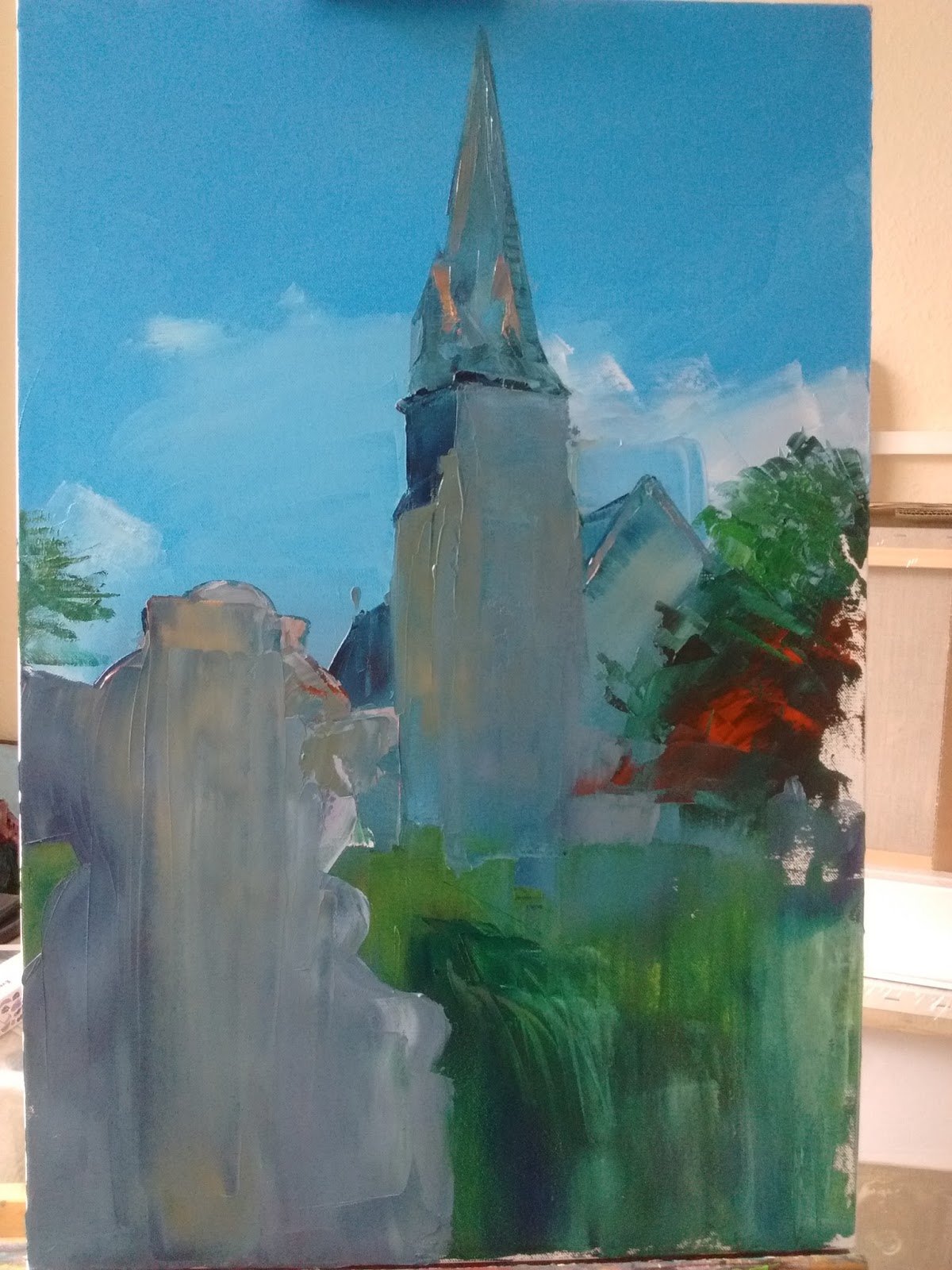
St Paul's is a wonderfully elegant Victorian church on the edge of the Hampshire village of Ashford Hill, a few miles from my home. This view represents my first view of the building when I was walking in the area last spring: the tall, narrow spire emerging from lush greenery. However, the source image was taken more recently - a week last Sunday - and from the edge of the churchyard, not from the more distant footpath.

I had a few problems with the spire, which wasn't straight when I first painted it, but I think I sorted it out.

Acrylic on canvas, 12 x 9"
05 June 2014

Wednesday, 18 September 2013

St Peter's in oil


I was pleased enough with my recent sketch of St. Peter's that I decided to use it as the basis of an oil painting (made with a knife, as ever). And here it is - St. Peter's church, Tadley, Hampshire.

Oil on natural colour linen canvas, 30 x 30 cm
17 September 2013

Tuesday, 10 September 2013

St Mary's in a Fairy Tale - SOLD

This is our local church, St. Mary's, but doesn't it look just a bit like a fairy tale castle? I took the source photograph on a lovely evening in July this year and I only heightened the colours a little; the façade fairly glowed in the setting sun's light.

Acrylic on box canvas, 20 x 26 cm
09 September 2013

SOLD

Monday, 24 June 2013

Kingsclere Jigsaw

This is the village I live in. There is a certain point at which you can see the downs rising behind the church tower like a wall of green. This is that scene rendered in felt tip pen on a formerly blank jigsaw.

Felt tip, marker pen and white acrylic ink on laminated card jigsaw board, 16 x 20"

SOLD (to the lady on her way to the Post Office, in the picture)

Wednesday, 26 December 2012

Porthleven from the Beach

I wasn't expecting to get the opportunity to paint yesterday, but I did. So I did.

This is based on a selection of photographs taken at Easter in 2010, when it was gloriously warm and sunny. They weren't intended to be a panoramic view (they just happened to join up), and I did remove a number of people, including, um, some in  the foreground. I didn't include quite all of the seaweed, either.

The church on the seafront is, I think, quite distinctive; it certainly says "Porthleven" to me.

Oil on canvas, 55 x 33 cm
25 December 2012
SOLD

Tuesday, 15 May 2012

Welby Church 1: Framed

← Lego Minifigures 43: "Legolas"                                 Lego Minifigures 44: "Arwen" →
(Original Welby Church post)

What do you think of the choice of frame? I quite like it - nice and broad, simple (like the subject), and the yellow wood seems to pick out the sandstone of the church. The frame was, ahem, a sale bargain. The subject was serendipitously on my list of things I wanted to paint, and when I was considering what size and shape to make the painting, I remembered the little canvases that fitted these frames. And the colour of the frames...

Thursday, 3 May 2012

Welby Church, Leicestershire

This is Welby Church in Leicestershire, on the edge of the market town of Melton Mowbray.  I grew up in Melton, and the building is special to me. Its incongruity - the church without a village - its isolation (it can seem like a lonely edifice, particularly on grey, wintry days like the one that this image represents) - its sense of history and, perhaps most important to me when I was a teenager, the way that it seemed to represent rurality in close proximity to the town.

The medieval village of Welby is no more - it was "lost" due to enclosure between 1450 and 1700 (i.e. the local landowner decided that sheep were less bother than crops - which required a lot of agricultural labour, increasingly expensive after the black death - and so the villagers were evicted and the common land enclosed). The site is now classed as an "Antiquity (non-Roman)".

The church is the most obvious remnant. It sits just shy of the crest of the hill on a narrow lane, and is constructed in local sandstone. It is thought to have been built in the latter part of the 12th Century, in the time of the first Roger de Mowbray. Services are still held there, although not regularly. It seems to be a popular little church - on the occasion of a service, the sides of the little lane are usually clogged with parked cars.

These days, its nearest neighbours are a farm and the site of a former (never functional) coal mine, now a business park. Not much further away, Melton's sprawling residential fingers provide a cohort of leisure walkers who often use the building as a landmark.

Sources:
Lost Villages
Explore Britain
Local Diocese
The painting is based on a couple of photographs that I took on a recent visit to family in the area. It's rather small - I had limited time this afternoon, and it occurred to me to create something to fit in a frame that I already have. But, then, the church itself is not grand. I think that the size suits the subject.

And here are some in-progress shots:


Actually, the last one is the finished version, but it's a different photograph. All of this sequence were taken with the canvas on the easel (although the light is different on the final one - I turned the easel to face the window). The main picture was taken with the canvas lying flat.

Oil on canvas, 10 x 8"